
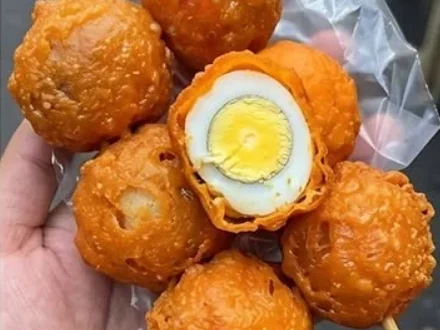
Hard-boiled quail eggs are coated in batter and fried for this small snack. The eggs are cooked before frying; the oil cooks the coating and warms the center. This recipe uses orange coloring, but the color is optional and does not indicate doneness. The batter needs to cling to a dry egg rather than slide straight off it.
Before you start
Boil the quail eggs until both yolks and whites are firm, using the approximate time of 4–5 minutes as a starting point rather than a universal guarantee. Cool enough to handle, peel carefully, and dry the surfaces. Water left on the eggs makes coating more difficult and can cause hot oil to splatter.
Food coloring concentration varies widely. Use only food-grade coloring according to its label, or omit it. Do not repeat a tablespoon blindly with a concentrated gel or powder. The seasoning and cooking method do not depend on achieving a bright orange color.
ROMANIV · Recipe card
Crisp Battered Quail Eggs
Ingredients
Check off ingredients as you prepare your workspace.
- 12 quail eggs
- 1 cup all-purpose flour
- Up to 1 cup water, added gradually to form a coating batter
- 1 teaspoon salt
- 1 teaspoon black pepper
- Food-grade orange coloring, optional, according to its label
- About 2 cups frying oil, adjusted to the pan without overfilling
- Vinegar or dipping sauce for serving
Step-by-step method
- Hard-boil the quail eggs, approximately 4–5 minutes, checking that the yolks and whites are firm. Cool, peel, and dry thoroughly.
- Mix flour, salt, and pepper. Add water gradually until the batter coats an egg; add optional food coloring only according to the product label.
- Heat frying oil in a suitable pan to about 350°F, leaving plenty of headroom.
- Coat the eggs and lower them carefully into the oil in small batches.
- Fry approximately 2–3 minutes, turning as needed, until the coating is cooked and crisp. Adjust for your batter and pan.
- Drain with a slotted utensil and serve with dipping sauce.
Common mistakes and how to avoid them
The batter slips off: pat the peeled eggs dry and stir the batter before coating. A very watery mixture will not cover evenly; confirm the flour measurement and add the measured water gradually rather than all at once.
The coating is greasy: crowded eggs cool the oil and may stick together. Fry small batches and allow the oil to recover between them. A thermometer is more useful than judging heat from smoke, which is not the target.
The outside browns before the coating cooks through: excessively hot oil can color the surface too quickly. Maintain a controlled frying temperature and use a small first batch to assess the batter thickness and timing.
Serving and making ahead
Lift with a slotted utensil and drain before serving with vinegar or another dipping sauce. Serve soon after frying for the crispest coating; covering a pile tightly traps steam. Keep uncooked batter separate from ready-to-eat food and do not taste it raw because it contains uncooked flour.
Can I substitute breadcrumbs for flour?
Not directly in this batter. Breadcrumb coating requires a different sequence and does not mix with water in the same way.
Do I need orange coloring?
No. It changes appearance, not whether the eggs or batter are cooked.
Can I fry unpeeled eggs?
No. Peel the hard-boiled eggs first. The shell is not part of this coating, and leftover shell fragments should be removed before battering.
Reference: FoodSafety.gov cooking-temperature guidance, FDA guidance on raw flour.